Back in April, in Stop Prompting. Start Thinking., I described Worky as "an open-source project I'm building". Present tense.
That's no longer true. Worky is built. It works. I haven't touched it in months, and I don't use it.
This is the retrospective of how that happened. Not because the tool failed: the tool came out fine, and I'm still proud of it. What collapsed was the premise underneath it. And the way it collapsed taught me more about AI-assisted development than the building did.
Where Worky came from
Earlier this year I proposed a workshop to a conference. While waiting for the answer, I started preparing it: how I'd structure it, how participants would follow along, what the hands-on part would look like.
I went looking for tools to run that hands-on part and didn't like anything I found. The options were paid, cloud-based, or clunky. Nothing matched how I think a workshop should feel from the participant's seat: fast, local, zero setup friction, always knowing where you are.
So I thought: I could build this myself.
Here's the part that matters. Five years ago, that sentence would have died right there. A tool like this would have cost me weeks of evenings: a web server, progress tracking, content rendering, a CLI. I would have waited for the conference to accept the workshop before writing a single line. The cost of building was a natural validation gate. Too expensive to build on a maybe.
That gate is gone. I had the core of Worky working in one weekend. Then a few evenings over the next couple of weeks for refinements: three, maybe four days of actual work in total. So I didn't wait for the yes. I built on the maybe.
Not vibe coding, by the way
You could call this vibe coding: I described what I wanted, and the AI wrote most of the code.
I don't call it that, and not because the term offends me. The term is fine. The problem is what it has come to mean. "Vibe coding" now reads as a red flag: someone who doesn't think, doesn't check, lets the model generate whatever and ships the result.
What I did was the opposite. I designed the tool. I made the architectural decisions, pushed back on the AI's choices, had it push back on mine, and iterated until things worked the way I had them in my head. The AI wrote most of the code; I never lost track of what it was doing or why.
I described that whole workflow in Stop Prompting. Start Thinking., so I won't repeat it here. The short version: I stayed the senior in the room.
What Worky actually is
Worky deserves a proper introduction, because this is not a story about a bad tool.
Worky is a Go library for building self-contained workshop tools. You define your workshop as a Go program: chapters, content, checks. It compiles into a single binary that participants download and run. No Docker, no cloud account, no "first, install these six things" slide.
- One binary, everything included. Docs, checks, progress tracking, and the web UI all compile in. Content is embedded with Go's
embed, Markdown is rendered server-side, no build step. - Chapters unlock in sequence. Chapter two stays locked until chapter one's checks pass. Nobody skips ahead and gets lost.
- Checks are code.
FileExists,EnvVarSet,CommandSucceeds,HTTPStatusout of the box, or any custom Go function you want to write. - Real-time feedback. The browser UI updates over SSE as checks pass. Participants watch chapters flip from locked to done as they work.
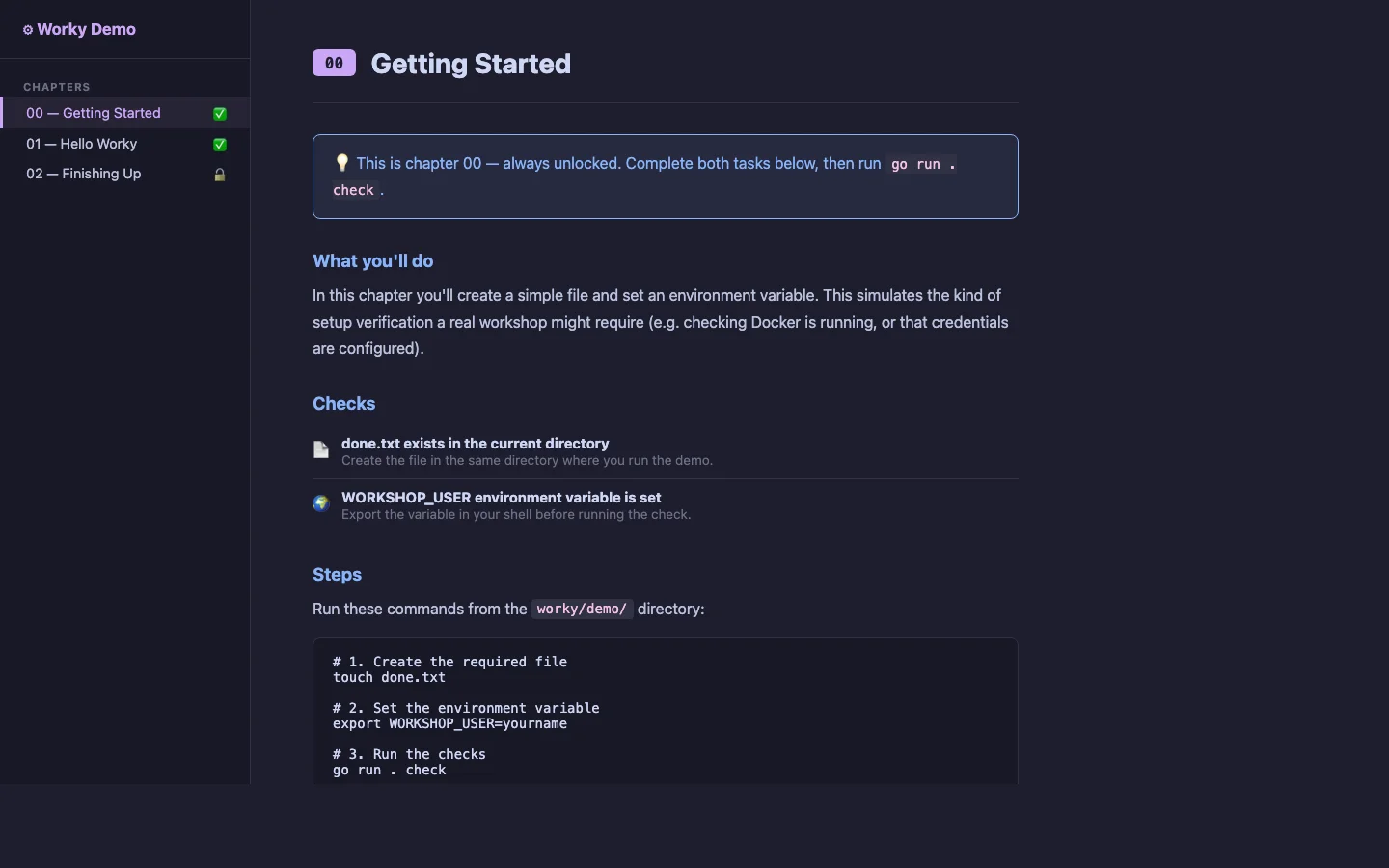
There's a worky init command that scaffolds a new workshop, and the repo plus a showcase site cover the rest. It's the workshop experience I always wanted as a participant: run one thing, follow along, see your progress move.
The premise collapsed
The conference said no.
Nothing dramatic. Proposals get rejected all the time, that's the game. But Worky existed for that workshop. Later I ran a different workshop, and it wasn't a fit for Worky either. And that was it: a working tool with no workshop to run.
For a while I told myself I'd get back to it. I didn't. And when I got honest about why, it came down to this: a tool without users can't tell you what to build next.
Sure, I could have created fake workshops to test it against. But testing what, for whom? I had no way of knowing how a real participant would experience it, where it would break in a real room, which missing feature would actually hurt. Usage is what generates requirements. Without usage, the roadmap is fiction.
That's what killed the motivation. Not failure. Purposelessness. There was no point left to reach, so my attention drifted to tools I actually use every day, and Worky quietly stopped being something I was building and became something I had built.
The repo currently has two GitHub stars. I'm at peace with that.
Would I do it again? Yes.
Strange thing to say in a retrospective about a tool nobody uses, but: absolutely yes.
Worky cost me a weekend plus change. In exchange, it was the project where I properly stress-tested the AI workflow I now use on everything. It was fun. And it answered its own question fast: is this idea worth pursuing? No. Getting that answer in days instead of months is not a failed product. It's a successful experiment.
That's the actual shift AI brought, and it's bigger than "AI writes code fast". Building became so cheap that building is the validation. You don't have to wonder for months whether an idea has legs. You build it and find out.
What I saw from the jury table
In late June we organized a hackathon at RedCarbon together with Regolo, at OGR Torino: one day, teams of one or two people, AI applied to security problems. I was on the jury.
The POCs that came out of a single day were the kind of thing that, a few years ago, a team that size wouldn't have finished in a week. Near-real projects, demoable by evening. And it wasn't just seasoned engineers: people who don't work in AI, some not even in security, showed up with an idea and shipped something working. I watched people use AI not just to build but to sharpen the idea itself: digging for the context they were missing, weighing one approach against another before committing.
Ideas have never been this cheap to test. That's the good edge.
The other edge was just as visible. The teams that struggled weren't short on building capacity; they were short on clarity. When the idea wasn't sharp, AI amplified the mess: more features, more components, more surface, less point. By presentation time, some projects were genuinely hard to explain. The demos that won were the simple ones.
I can't be smug about it, because I did the exact same thing with Worky. I started out wanting it to do everything. I wrote full documentation and built a showcase website for a tool that had zero users, because I cared about it and, well, what kind of tool doesn't have a showcase site? The right order would have been the opposite: ship the core, find real usage, then earn the packaging. When adding things costs nothing, the discipline of not adding them has to come from you.
The expensive decision moved downstream
So no, the lesson is not "validate before you build". Building is validating now, and it's cheap enough to do on a maybe. I did, and I'd do it again.
The lesson is that the expensive decision moved. Building Worky cost a weekend. Maintaining it (triaging issues, evolving it, caring about it over time) costs exactly what it cost ten years ago: sustained attention. AI made ideas abundant and code cheap. It did nothing to make attention abundant. Attention is the bottleneck now, and it doesn't scale.
Which means the judgment call changed shape. It used to be "should I build this?". Now it's "should I keep this alive?".
And that second question is harder than it looks, because attachment gets a vote. I liked Worky. I still do. I invested time in it, dressed it up as a product, and that made it slower to admit the obvious: this wasn't my mission. Not my use case, not a problem I meet more than a couple of times a year, not the thing I want to spend my evenings on. Letting go of a project you like costs more than letting go of one you're indifferent to.
Worky was the right project to build and the wrong mission to carry. Knowing the difference, before the maintenance bill arrives, might be the most valuable skill AI-assisted development asks of you.
It's yours if you want it
The original plan for this post was a launch announcement. "Introducing Worky", with a call for beta testers. I'm glad I never wrote it. Asking people to invest in a tool whose own author had stopped showing up would have been dishonest.
So here's the honest version instead.
Worky works, and it's open source. If you run workshops (meetups, conference hands-on sessions, internal training) and the single-binary, zero-setup experience sounds right to you, try it: start from the repo or the site.
And if it turns out to be useful to you, tell me. I'm not asking for a favor. I'm saying that real usage is the one thing that would put Worky back on my list, because users generate the roadmap I couldn't invent alone. If it earns users, it earns maintenance. That's the right order. I had it backwards the first time.
If you've got your own shelf of working tools you never use, I'd love to hear what's on it. Leave a comment or find me on LinkedIn.